
The Morning Range
Playbook
Watch the full walkthrough.
The Strategy
Primary trigger = opening 15-minute range. Secondary map = pre-market and weekly levels.
Range Breakout Strategy
Use this when price breaks the first 15-minute range (OR High/OR Low), then retests and confirms.
Mark the Two-Layer Map
At 9:45 AM ET, lock the first 15-minute opening range (OR High/OR Low). Keep PM High/PM Low (4:00-9:30 ET) and Weekly High/Weekly Low on chart as secondary levels.
Wait for the OR Break
After 9:45 AM ET, wait for price to break OR High or OR Low with conviction. Do not trade before the opening range is formed.
Wait for the Retest
After the OR break, do not chase. Wait for a retest of the broken OR boundary and use that hold/fail as your entry zone.
Confirm the Entry
Look for confirmation: a candle that holds the level and closes back in the direction of the break. For fewer fakeouts, wait for a second candle to confirm.
Set Your Stop
Stop goes just beyond the retest level — below it for longs, above it for shorts. Your risk is defined BEFORE you enter. If you don't know your stop, you don't take the trade.
Take Profit or Trail
First targets are PM High/PM Low, then weekly extensions if momentum stays strong. Don't hold and hope - define exits before entry.
Know When to Stop
Only take entries between 9:45 AM-1:00 PM ET. The first 15 minutes after open are noise, and late afternoon often becomes low-conviction chop.
Sideways Support/Resistance Strategy
Use this when OR break attempts fail and price rotates between OR, PM, and weekly boundaries.
Mark Support + Resistance
Use OR High/OR Low as the nearest boundaries, then PM High/PM Low and Weekly High/Weekly Low as outer boundaries. Avoid entries in the middle.
Wait for Edge Interaction
Wait for price to touch or sweep the top/bottom boundary first. No touch at a key level means no trade.
Confirm Rejection
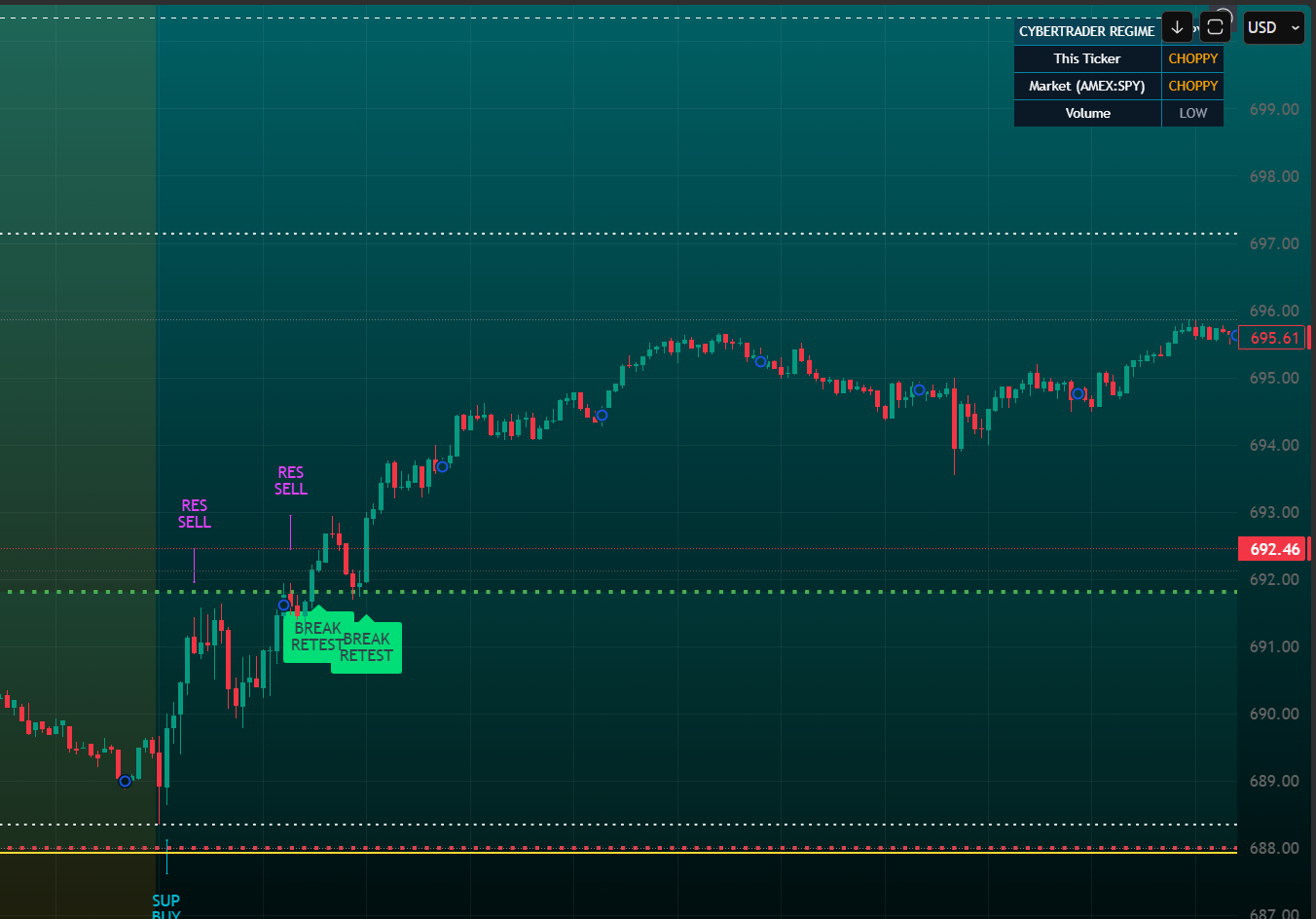
Take RES SELL only after clear rejection at OR/PM/Weekly resistance, and SUP BUY only after clear bounce at OR/PM/Weekly support. Enter on close back inside the range.
Stop + Target Rules
Stop goes beyond the rejection/bounce wick. Target 1 is range midpoint, target 2 is the opposite boundary.
Stand Down Conditions
If candles are compressed, wicks are erratic, or levels are not cleanly respected, skip the setup and preserve capital.
Full Written Tutorial
Watch the video, then open each section below as a step-by-step reference.
1) What You Need Open Before The Bell
First, open TradingView. Free version is fine to learn. If you want cleaner real-time behavior, use a paid feed or connect your broker.
Load your chart, for example SPY. Then:
- Right click chart -> Settings -> Session
- Turn on Extended Hours so you can see premarket and postmarket
I shade premarket and postmarket so it is visually obvious. Premarket is where we build our first external levels for the day.
2) Core Levels To Mark Every Day
Before the 9:30 a.m. New York open, mark these levels:
- Premarket high
- Premarket low
- Current week high/low
- Previous week high/low
These levels are your map. Price moves from level to level. Your job is reaction at levels, not prediction.
3) The True First Range: ORB (15-Minute Orbital Range)
The first range we respect is the ORB from the first 15-minute candle.
Do not take trades at 9:31, 9:33, or 9:38. Wait for the first 15-minute candle to close at 9:45, then mark:
- Opening Range High
- Opening Range Low
Order of levels:
- ORB (first 15 min)
- Premarket high/low
- Previous week high/low and current week high/low
4) Entry Logic (Simple and Repeatable)
After ORB is marked, drop to 2-minute or 3-minute chart for entries.
Long setup:
- Price breaks and closes above ORB high
- Wait for retest hold
- Enter on confirmation candle
- First target is premarket high
Short setup:
- Price breaks and closes below ORB low
- Wait for retest failure
- Enter on confirmation candle
- First target is premarket low
Do not chase the breakout candle. Let the retest do the work.
5) Support Buy / Resistance Sell Framework
- SUP BUY: level holds and price defends -> long continuation or bounce
- RES SELL: level rejects and fails -> short continuation or rejection fade
When levels break, roles can flip: old resistance can become support, and old support can become resistance.
6) Regime Filter (When To Trade, When To Walk)
If market is choppy, low volume, and inside ranges, this strategy gets noisy.
- Reduce size
- Take fewer trades
- Or skip
If trend and volume are aligned, ORB breaks and retests tend to follow through better.
7) Example Walkthrough (SPY)
SPY opens, first 15-minute candle closes, ORB is set. If price breaks below ORB low, retests, and fails, that is your short trigger.
Target 1 is premarket low. If that level breaks and retests from underneath, next downside objective becomes weekly lows.
Opposite case: break above ORB high, retest holds, target premarket high, then weekly highs.
8) Weekly High/Low Nuance
Early week, current week highs/lows are still forming, so previous week levels are often stronger rails.
By Thursday/Friday, current week highs/lows become more meaningful reaction zones.
9) Risk Rules (Must Follow)
- Wait for ORB close first
- Enter on retest, not breakout chase
- Pre-define invalidation before entry
- Scale out at logical levels
- Be mostly done by late morning unless structure is very clean
10) Tools + Community
Grab and test the Morning Range Playbook tools and Regime Dashboard live on chart.
Use them as a checklist with price action, not as blind signal buttons.
Then come to Discord, post chart marks, and discuss execution with the community.
11) Close
Mark ORB first, trade retests, then work level-to-level through premarket and weekly structure.
One clean trade with rules is better than five random entries.
Playbook PDF + Breakdown
Use the same ORB-first framework in both the interactive breakdown and printable playbook.
- ✓ Opening-range-first (9:30-9:45 ET) trigger model
- ✓ PM/Weekly level targeting and rejection logic
- ✓ Futures-safe checklist to avoid forcing chop days
- ✓ Defined stop, target, and no-trade filters
Apply It by Market
Use the same ORB-first model across stocks, futures, and options with market-specific sizing notes.